


Kane Parsons' Backrooms (2026) Review

Kane Parsons' Backrooms is undeniably impressive. It satisfies that craving for nostalgic dread that got my friends and I hooked on the movie and the lore in the first place. What once only existed on our computer screens was finally recreated on the big screen. And there's no arguing it. Parsons, indeed, has displayed a commendable talent in manipulating atmosphere for a first-time feature director. Unfortunately, atmosphere can only carry a film so far before it gets dragged down by the script.
The greatest strength of the Backrooms as a concept has always been its ambiguity—the mystery of being somewhere familiar yet profoundly wrong. But rather than trusting that premise, the film becomes a psychological character study.
To be clear, though, I’m not saying that horror-as-metaphor is inherently a problem. I adore this narrative strategy. In fact, some of the genre's best films use supernatural elements to explore psychology. The main issue here is that Backrooms states these ideas instead of developing them.
The result is a film caught between two identities. It wants to be an abstract nightmare and a character-driven drama all at once, but neither side gets the attention it needs, which leads to the plot's biggest weakness: relying too heavily on telling rather than showing.
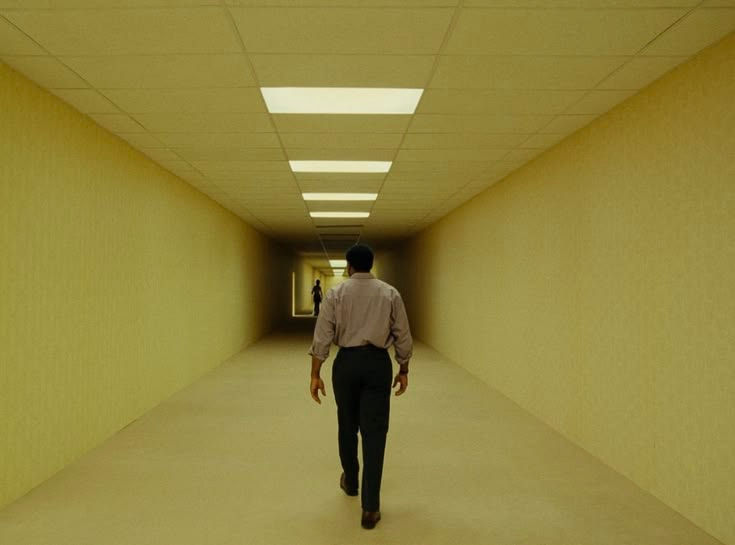
The Backrooms themselves are already interesting on their own. Their endless hallways and repetitive architecture already communicate feelings of isolation, anxiety, and being trapped far more effectively than words can. Yet, the film sometimes interrupts that visual storytelling with therapy sessions and dialogues just to spell out that Clark is a disturbed guy.
To be fair, several critics have praised the film for restraining itself on the mythology side. We never learn what the Backrooms are or why it exists. But that restraint doesn't extend to the emotional core of the film. The central metaphor that trauma keeps you walking in circles, "reaching for the same solution over and over again, thinking each time they'll take you somewhere new. But they don't,” is stated almost verbatim early in the film, in a monologue that hands the audience the film's thesis without even giving them a fighting chance to earn it.
The lore stays ambiguous while the theme does not. And it's the theme, not the lore, that needs to be interpreted by the audience without the crutches.
What makes this especially frustrating is that the film's strongest moments appear when it abandons explanation altogether. When it's simply characters wandering an impossible corridor, curious and frightened, walking through rooms without knowing what’s ahead. In these scenes, Backrooms becomes genuinely terrifying, because it trusts the audience's imagination. The script, unfortunately, never extends that same trust.
This is not a bad film. Actually, it’s far from it. Parsons is a talented visual storyteller. Yet, in the end, Backrooms is a reminder that imagery alone cannot compensate for a screenplay that never quite finds its footing.
Edited by reux z. qualm


Comments